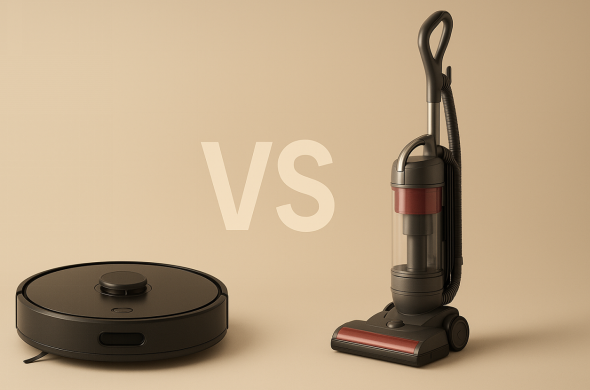
If you were raised on someone “doing the big clean” each week with a heavy upright, it can feel wrong to trust a little disc-shaped robot vacuum with the same task. Old-fashioned uprights continue to win most lab tests for suction power and deep carpet cleaning, particularly on thick rugs and stubborn pet hair.
But in the real world, a tiny robot vacuum that runs quietly each day might just leave a home looking cleaner than a “monster” upright that only prowls on weekends. The secret is knowing where each kind of machine can shine and when a cleaner robot vacuum will actually get you better results with less effort.
This guide breaks down robot vacuum vs upright performance in everyday homes, then explains when the little guy is the more sensible main cleaner, and when you still want to keep the big gun in the closet.
Robot brains vs upright muscle: the old rule of thumb
For years, the rule of thumb was easy enough:
Use an upright for power. Go robot vacuum to save you the hassle of pushing around a heavy machine.
A traditional upright and a powerful corded stick is generally going to be equipped with a beefier motor, more airflow and a larger brush roll. That combo can still give them an edge in pulling embedded dirt, sand and pet hair from deep carpet piles. Uprights’ cleaning performance on carpet is frequently better than that of robots in independent tests.
The robot vacuums, meanwhile, were created from the ground up for automation. A suite of sensors, including a regular camera for navigation purposes, as well as compact motors and small dustbins allow them to trundle around rooms and clean up after themselves, often fully controlled over a smartphone app or via smart speaker.
On paper, then, the upright wins when it comes to the “who’s stronger” contest. But suction at the end of that long wand tells only part of the story behind cleaning results. It is a matter of how frequently you clean, where dust lurks and, most importantly, how much time you’re actually willing to devote to pushing a vacuum cleaner.
Why big uprights still matter
Before we hand the crown to the compact robot vacuum, let’s face it: Your high-suction upright is still MVP.
Deep cleaning thick carpet
For wall-to-wall medium or high-pile carpet, nothing beats a strong upright or canister with a powered brush head as the quickest way to do a real deep clean. The machine’s weight, the agitation from the brush roll and the increased airflow all contribute to pulling debris that a small robot would likely leave behind, especially in high-traffic areas.
Big messes and “uh-oh” moments
Cereal spillage, potting soil or glitter from a school project? It is easier to target the mess directly if you have an upright or powerful stick which is pointing at it. Robot vacuums are not made for your deep cleaning needs, just as they’re not built to do emergency cleanings on a pile of dirt.
Stairs, upholstery and cars
Robots aren’t an option for cleaning stairs, and they’re cumbersome for car interiors and upholstery. An upright or a stick still does these tasks better.
So no, the monster standing isn’t “dead.” But the question is: Do you still need it to be your workhorse cleaning every single week, or can a tiny robot vac take on 80-90% of the job?
When a small robot vacuum prevails silently
This is where the mini machine begins to outpace the monster in day-to-day living.
Frequency beats intensity
People don’t generally deep-clean their floors on a daily basis. The vacuum comes out once a week in many homes, every other week or when life gets crazy. In between, you’ll find dust and crumbs and pet hair and grit.
A robot vacuum is a reversal of that pattern. You program it to go on once a day, or every other day while you’re at work or lounging on the couch. This way, rather than waiting until a mess is visible, the robot consistently knocks dust and debris down before it can get ground into carpet fibers or dragged across hardwood.
In practice, that means the house often looks and feels cleaner, even if each individual pass of your robot through isn’t as potent as a full upright session.
Densely spaced between/beneath beds, couches and tight spaces
Peek under most beds or low-slung sofas, and you see evidence of both in the form of dust bunnies and pet hair tumbleweeds. Uprights don’t cut it here: Your head may fit, but the rest of your machine doesn’t.
Dust that an upright never sees can be sucked up by a robot sweepstake, which slips under furniture each day because it is so low-profile. For small apartments, studio living spaces or homes with plenty of low furniture, that under-the-radar cleaning has a lot going for it.
Busy schedules and mobility issues
If you’re a long-hour worker, a parent or just don’t like vacuuming all that much, the difference between something you set on automation and “wait for it to be disgusting” is not whether automation is real. It is the choice between “my floors are pretty clean in general!” and “I’ll do it this weekend… maybe.”
For seniors, or for anyone with issues regarding the back or joints, a robot vacuum can be the difference between living in an area that’s constantly dusty and one that’s actually clean. Once it’s installed, your primary “job” is emptying the bin or self-empty base and sometimes cleaning filters and brushes.
Noise and stress levels
Many uprights are loud enough to make you stop talking, or the need to turn up the TV. Robots are much quieter, and you can set them to run while you’re gone or in another room.
That matters if you work from home, have small kids or live in an apartment where sound travels. A small robot buzzing by at 10 a.m. is a lot less stressful than pulling out the monster upright during your last free hour of the night.
Specs that matter more than “maximum suction”
If you want your robot vacuum to be able to compete against a strong upright, you can’t trust the marketing numbers.
Navigation and mapping
Basic “bump and roam” robots are still out there, but the best cleaner robot vacuum models utilize either lidar or camera-based navigation to map your rooms, dodge obstacles and clean more thoroughly.
Solid mapping leads to fewer missed spots, smarter room-by-room scheduling and reduced risk of the robot eating cables or being trapped by clutter. In day-to-use, smart navigation can be more important than a just slightly higher suction rating.
Battery life and bin design
If you have a large house, battery life and the ability to recharge at least once, for models that can do so, are more important than peak power. One that can clean the entire floor in one charge, or come back to where it left off, is going to keep your space consistently tidy without you needing to baby-sit.
These self-emptying bases sound like a luxury but make a real difference. You empty a larger bag every couple of weeks instead of an itty-bitty bin every day. That can be a big quality-of-life upgrade for pet owners or allergy sufferers.
Filters and allergies
Contemporary uprights and the more sophisticated robot vacuums have high-efficiency or HEPA-style filters that catch fine dust particles and allergens. Uprights typically have bigger filter assemblies, though robot vacuums even out the playing field by running more frequently and keeping things from building up to begin with.
If you or someone in your household has allergies, a HEPA-equipped robot and the occasional upright deep clean can be more effective than counting on one big weekly clean.
The smart combination: robot daily, upright sometimes
The optimal arrangement in many homes is not “robot versus upright” but “robot combined with upright.”
You leave the robot vacuum to its business of daily dust, crumbs and fur on hard floors and low-pile rugs. It operates while you’re busy elsewhere, keeps things looking neat and greatly cuts down on how often you’ll need to haul out the big machine.
And then once a week, or perhaps only one or two times in a month, you get your high-suction upright or corded stick out for a focused deep clean on carpets, edges and the stairs.
That way, you truly get the best of both worlds:
Floors that look fresh most of the time, thanks to the robot.
Real deep cleaning with a cordless design, and stair compatibility courtesy of the upright.
In practice, this tag team often leads to less total effort and cleaner results, even in homes with pets and kids.
Choosing mains cleaners: how to pick which one should be the main cleaner
If you’re trying to decide which account deserves your dollars first, here’s one way to think about it.
If you have a lot of hard floors with some low-pile rugs or get sick of looking at dust and crumbs every day, the robot will definitely become your primary cleaner, with a cheaper stick or handheld as a backup. Robot vacuums tend to be pretty effective on hard floors and short carpets, where they don’t need a lot of suction.
If your home has a wall-to-wall high pile, multiple shedding dogs and stairs, and you can only have one machine, then a high suction upright or powerful cordless stick is still going to be the better main tool. You can always buy a stock robot later, to fill in for cleaning in-between deep sweeps.
If you already have a decent upright that’s going strong, buying a capable robot vacuum cleaner is often the biggest consumer upgrade. You reserve the monster for some heavy lifting every now and again, and let the mini machine handle the boring daily work.
FAQs
Is a robot vacuum a good replacement for an upright vacuum?
In a small dwelling with hard floors and low-pile rugs, a good robot vacuum can handle nearly all routine cleaning if it is run often. But for thick carpets, heavy pet hair or big spills, the Shark APEX DuoClean with Zero-M or a similarly powerful stick vacuum is still going to do a better job cleaning deeply and attacking concentrated messes. For most homes, a robot for daily upkeep and an upright part of the time works best.
Can a robot vacuum handle pet hair on carpet and couches?
A good robot with rubber rollers and decent suction can perform great on hard floors and short carpet pet hair, simply due to how often it runs. Note: Traditional vacuums with pet tools still work better for deep-pile rugs, as well as furniture and car seats. Consider the robot as your daily fur patroller, and the upright or handheld as your sniper spot cleaner for upholstery and troublesome places.
How long do I need to run my robot vacuum for optimal performance?
From speaking to people I trust who have one, it seems many find the optimal trade-off between battery life and cleanliness by running a robot vacuum once a day in high-traffic areas and a couple times per week in bedroom or guest spaces. It is because it operates automatically and quietly, versus a significant number of uprights, so frequently running the robot is often more practical than manual vacuum sessions would be until you feel compelled to spend around $150 on one.
Are robot vacuums good for multistory homes?
Robot vacuums are able to clean more than one level of your home, but they cannot climb stairs. You must move them manually, or purchase a second unit for the other floor. A lot of models also have the capacity to retain maps for multiple floors, so it’s a simple job to switch zones in the app after you put both your robot and its dock upstairs or downstairs. Stairs themselves will still need a regular vacuum or handheld.
How long does a robot vacuum typically last, and what maintenance is needed?
The average robot vacuum should last many years with minimal care. You’ll have to empty the bin or base, wash the filters, remove tangled hair from brushes and replace side brushes and even the main roller once in a while. You might also need a new battery at some point. The upside is that every maintenance task is a short one, and you’re still doing far less physical cleaning than lugging an upright up and down the stairs.