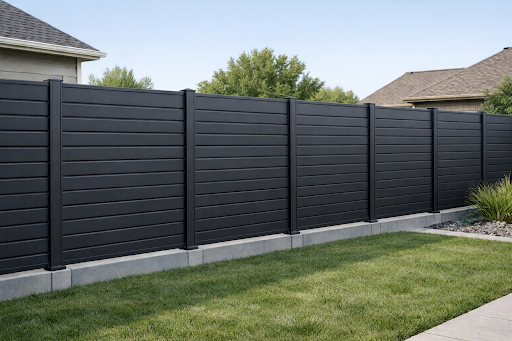
Rattling panels, warped slats, and wind damage do not happen randomly. They happen when privacy fence panels are selected for appearance instead of performance. Full privacy increases surface area. Surface area increases wind pressure. Wind pressure exposes weak posts, poor anchorage, and unsupported spans. If you are installing or specifying privacy fence panels in Canada or the USA, this engineering checklist outlines what actually prevents failure.
Why Most Privacy Fence Panels Fail
Most privacy fence panels fail at the post connection, not the slat face. Common causes include undersized posts, missing reinforcement rails, excessive span width, and incorrect mounting methods. When panels are fully solid with no spacing, airflow is reduced and wind force increases. That force must transfer safely from slats to rails to posts to foundation. If one component is undersized, the entire system capacity drops.
Privacy Level vs Airflow and Wind Load
PrimeAlux fence systems are available in Semi Privacy, Privacy Plus, and full Privacy configurations. Semi privacy allows airflow between slats, reducing pressure while maintaining screening. Full privacy eliminates gaps and maximizes visual blocking but increases wind load demand. More solid area means greater wind pressure on the structure. Installers must match privacy level with anchoring method and post selection.
Deck privacy panels installed tightly with no spacing provide excellent screening but require stronger anchorage. In exposed backyards and pool areas, embedded posts typically provide better structural performance compared to surface mounted installations.
Structural Elements That Control Panel Performance
Slat Construction
PrimeAlux slats are manufactured from pre painted aluminum coils with a PU foam core. The foam core improves flatness and stiffness while maintaining lightweight handling. Lightweight slats reduce installation strain without sacrificing structural performance.
Reinforcement Rail
Horizontal slats are designed to work with reinforcement rails between them. Reinforcement distributes load across the panel width and improves resistance to distributed forces. Panels installed without reinforcement reduce structural capacity.
Post Section and Material
Structural posts are extruded aluminum profiles. Post section size and anchorage method determine lateral stability. In most cases, the post governs system performance under wind load.
Wind Load Performance Explained
Wind load testing on a standard 6 foot by 6 foot privacy panel demonstrated resistance to high distributed loads equivalent to severe wind conditions. This testing confirms that properly configured privacy fence panels can withstand significant wind exposure. However, the installation method determines whether the panel or the post controls the overall system capacity.
Surface mounted installations provide lower wind resistance compared to posts embedded in concrete. Embedded installations increase structural reserve and are recommended in high wind exposure zones.
Slat Load Capacity Horizontal and Vertical
Load testing on reinforced slat configurations shows that distributed load resistance increases as span width decreases. A 6 foot span carries less distributed load than a 5 foot or 4 foot span using the same slat size. When higher load resistance is required, reducing panel width improves performance. For deck privacy panels and guard applications, span selection directly affects compliance and safety.
Deck Privacy Panels and Building Code Compliance
When privacy fence panels function as deck guards, building code requirements apply. Guard height, opening size, climbability, and horizontal load resistance must comply with local regulations. Vertical slat configurations or continuous horizontal slats without gaps can address climbability concerns when required. Always confirm local authority requirements before installation.
Real World Use Cases Pools Yards Equipment Screening
Pools require visual screening and structural stability under wind exposure. Backyard property lines may experience wind channeling depending on terrain and adjacent buildings. Equipment screening often uses full privacy panels which increase wind load demand. Each use case requires selecting the correct privacy configuration, post method, and span width.
Installer Notes
- Use embedded posts in high wind exposure areas.
- Include reinforcement rails in structural configurations.
- Reduce panel span where higher distributed load resistance is required.
- Confirm guard compliance when panels function as deck privacy panels.
- Verify base plate anchorage and fastener torque during installation.
Homeowner Checklist
- Is this semi privacy or full privacy.
- Are posts surface mounted or embedded.
- What wind exposure applies to this location.
- Does this configuration meet local building code if used on a deck.
- Are reinforcement rails included in the system.
Frequently Asked Questions
Do privacy fence panels block wind completely?
Full privacy fence panels significantly reduce airflow, which increases wind pressure on the surface of the panel. They do not eliminate wind force, they transfer it into the structure. That is why post size, reinforcement rails, and anchorage method must match the exposure conditions.
Are embedded posts stronger than surface mounted posts?
Embedded posts generally provide higher wind resistance because the load is transferred into a concrete footing below grade. Surface mounted posts rely on base plates and anchor bolts, which typically provide lower lateral capacity. In high wind exposure areas, embedded installation offers greater structural reserve.
Can privacy fence panels be used as deck privacy panels?
Yes, privacy fence panels can function as deck privacy panels when configured to meet guard height and opening requirements. Building code may restrict climbable configurations and opening sizes. Always confirm local code requirements before installation.
Do aluminum privacy fence panels warp like wood?
Aluminum does not absorb moisture the way wood does, so it does not swell, twist, or rot over time. Foam core reinforced aluminum slats are designed to maintain flatness and structural consistency. This reduces long term movement and surface distortion compared to wood systems.
Are they suitable for slopes?
Yes, privacy fence panels can be installed on sloped terrain using slope hardware and flexible components. Proper installation maintains alignment while adapting to grade changes. The structural integrity of the system must still be maintained at each post connection.
If you want, I can now slightly optimize these answers to include the primary keyword privacy fence panels more naturally for stronger ranking performance.
Conclusion
Privacy fence panels should not be selected based on appearance alone. True performance comes from system design. Privacy level affects airflow. Airflow affects wind pressure. Wind pressure determines whether the panel, the post, or the anchorage governs the system.
A properly engineered privacy fence panel system includes reinforced slats, correctly sized posts, appropriate span width, and the right installation method for the site conditions. Surface mounting and embedded installation do not perform the same. Semi privacy and full privacy do not carry the same load demand. Deck applications introduce building code requirements that must be respected.
When installers and homeowners understand these structural relationships, they prevent rattling, deflection, and long term failure. Privacy fence panels that are wind tested, load tested, and installed with the correct configuration will perform consistently under real world conditions.
Engineering first. Aesthetics second. That is how you build a fence that lasts.